
Commercial Market or Extortion Scheme? Money Changers and Goldsmiths Protest in Kunduz.
A number of money changers, goldsmiths, and mobile phone vendors in Kunduz province say that three construction companies, in collusion with local Taliban authorities, have forcibly collected more than two million dollars from shopkeepers for the construction of the “Galaxy Market.”
According to the shopkeepers, the money was collected before the shops were built and without specifying their exact location, floor, or shop numbers, and was accompanied by threats to seal their existing shops.
They describe this practice as contrary to Sharia and the law, and are demanding the immediate return of the money they paid.
The shopkeepers say construction of the market has only recently begun and will take between one and a half to two years to complete, yet the Taliban have forced them to make heavy advance payments up to $40,000 per shop—often in installments.
Local sources add that hundreds of thousands to millions of dollars have been collected from mobile phone vendors, goldsmiths, and money changers, and that shops are sealed if payments are refused.
Money changers warn that the market does not have sufficient capacity to accommodate all of them and that operating exchange businesses on upper floors is practically impossible, increasing concerns about potential financial losses.
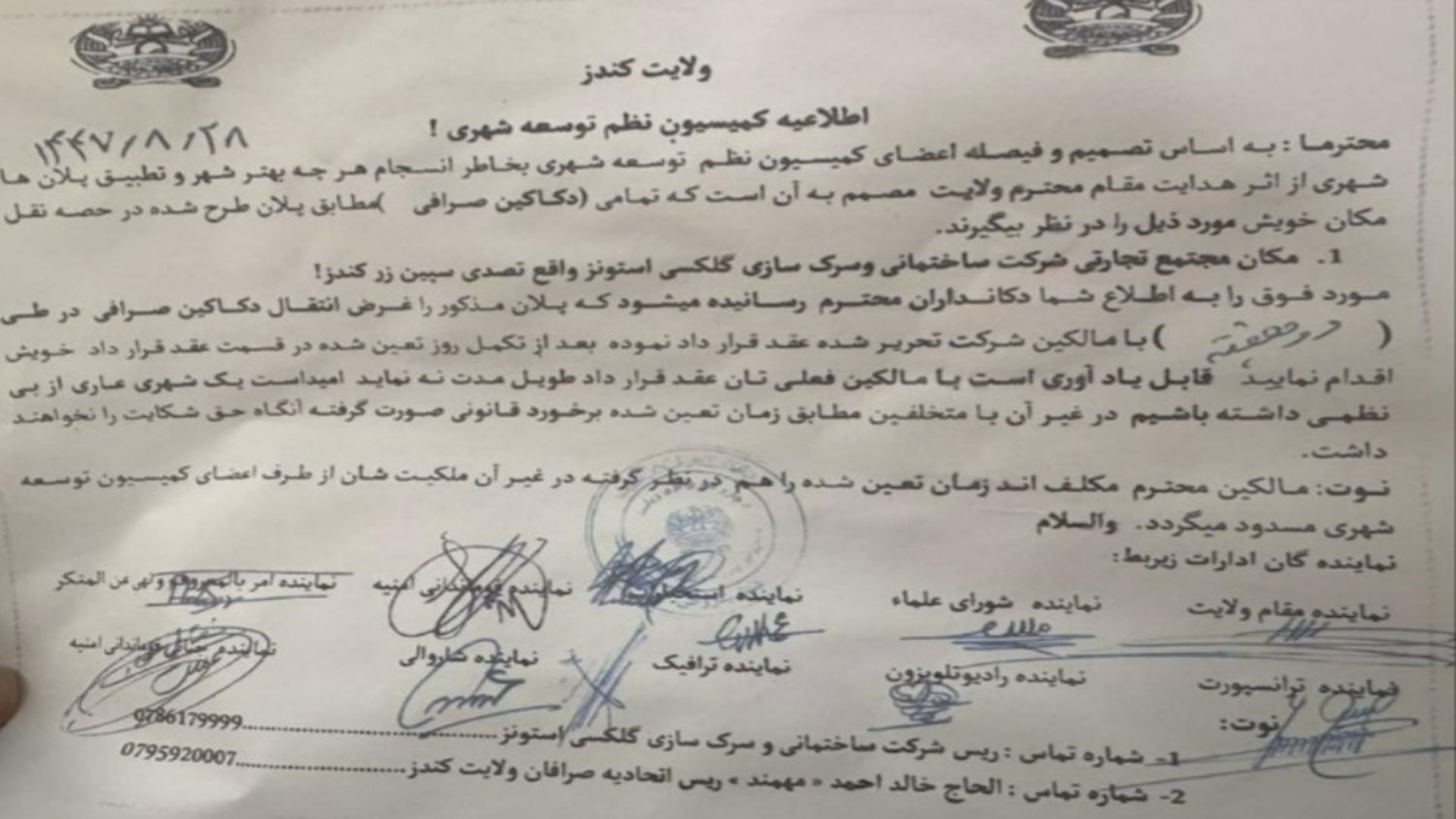
Meanwhile, the Taliban’s Urban Development Regulation Commission in Kunduz has sent letters ordering shopkeepers to sign shop-transfer contracts with the construction company within two weeks, warning that “violators” will face action if they fail to comply.
Rejecting this decision, shopkeepers insist that the money was collected through coercion, threats, and deception and must be returned to its owners. They are calling for an immediate halt to the pressure, the cancellation of forced contracts, and accountability for those who, they say, are exploiting the project for personal gain in collusion with local Taliban officials.